
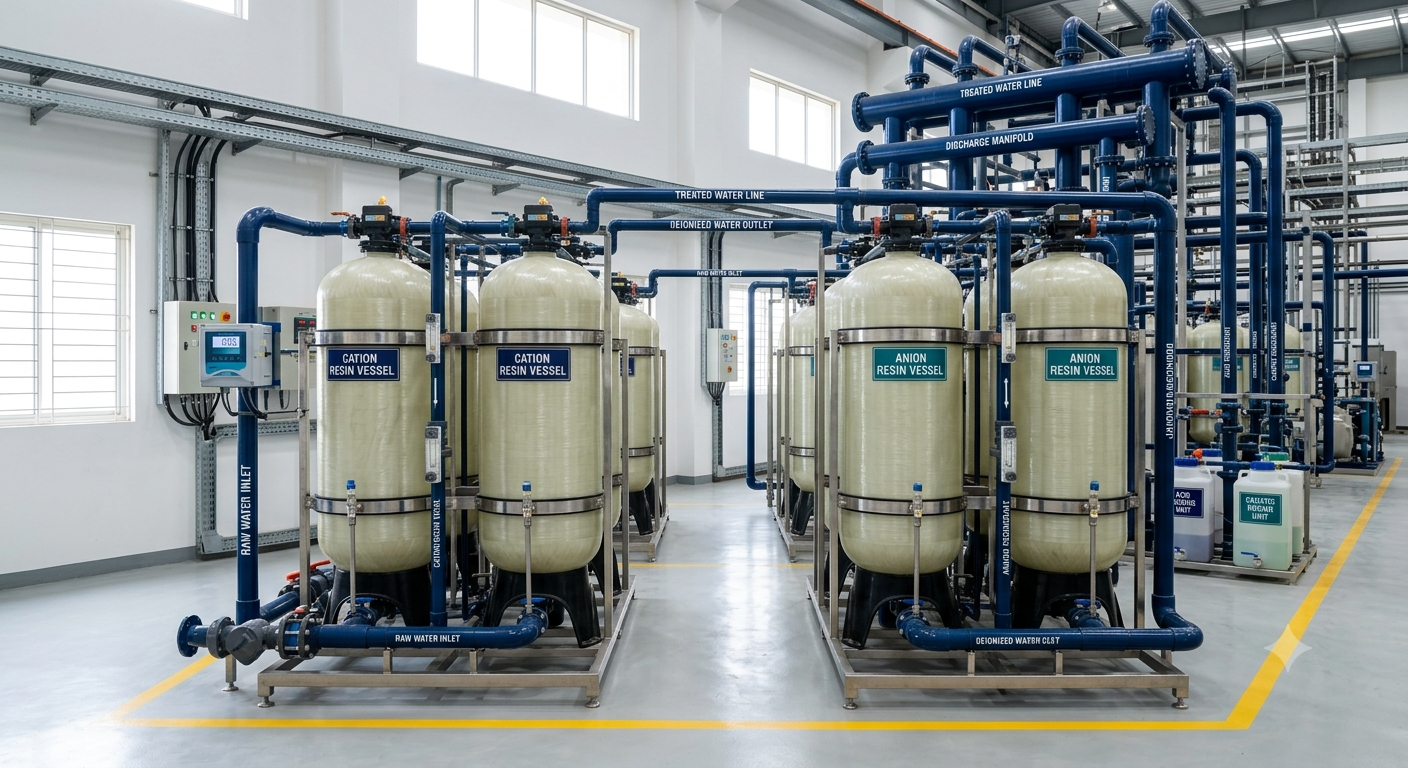
Demineralisation (DM) Plants for boiler feed water and high-purity process water. Ion-exchange resin systems that remove dissolved salts to produce < 1 µS/cm conductivity water — essential for boilers, pharma and power plants. Manufacturing, installation & AMC in India.
A Demineralisation (DM) Plant removes virtually all dissolved ions — calcium, magnesium, sodium, chlorides, sulphates and silica — from water using ion-exchange resins, producing water with near-zero conductivity. This level of purity is essential for high-pressure boiler feed water, where even small amounts of dissolved minerals cause scaling on heat transfer surfaces and can lead to costly boiler tube failures, and for process applications like electronics manufacturing, pharmaceutical formulation, and laboratory use.
Calcium, magnesium, sodium, chlorides, sulphates and silica — virtually all dissolved ions that cause scaling and corrosion in boilers and interfere with sensitive manufacturing.
High-pressure boiler feed water, electronics, pharma formulation, laboratory use — Ions India designs DM plants for industries where feed water purity is not optional but operationally critical.
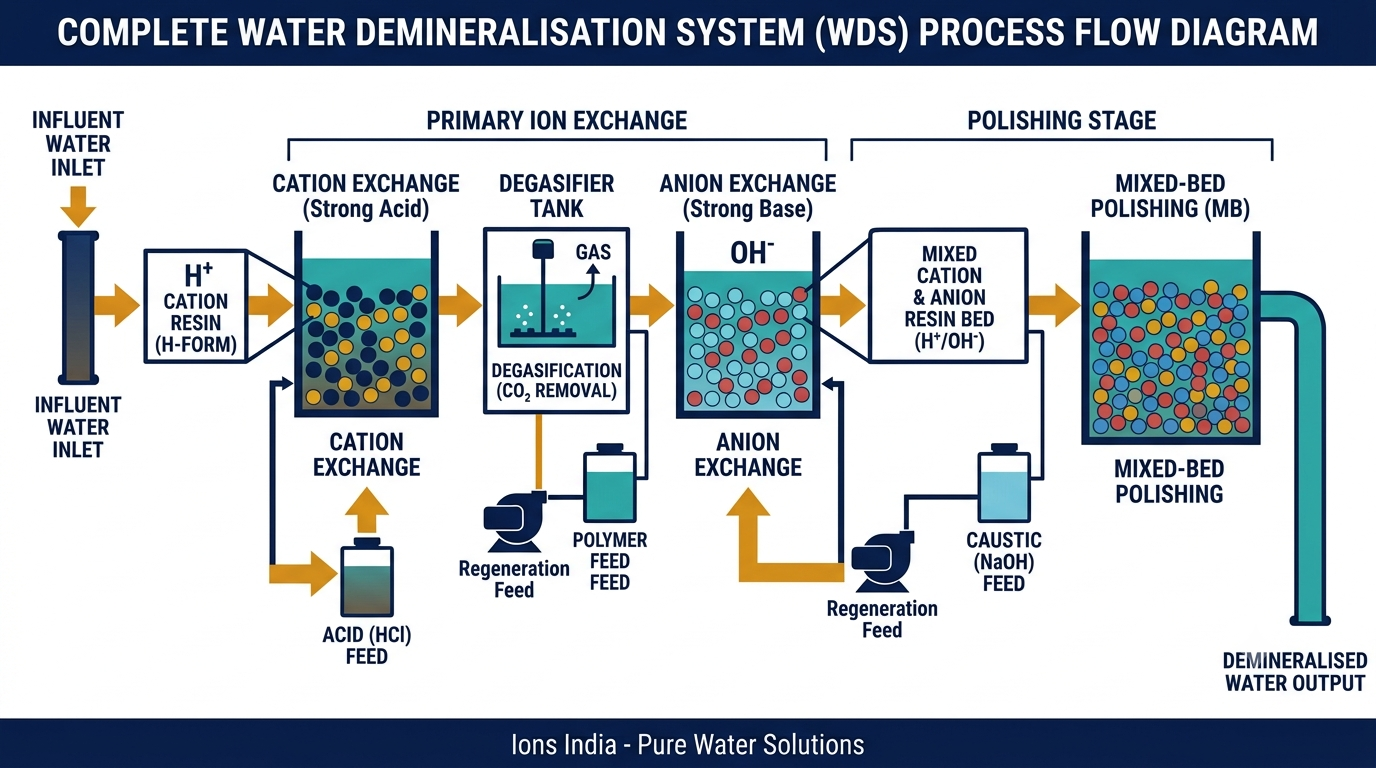
Our systems typically use a two-bed configuration — strong acid cation resin bed followed by strong base anion resin bed — or mixed-bed polishing for highest purity like boiler feed for high-pressure boilers or semiconductor-grade water. Raw water is usually pretreated through softening or RO stage before entering DM system.
Cation exchanges Ca, Mg, Na for H+. Anion exchanges chlorides, sulphates, silica for OH-. H+ + OH- = pure H2O. Resin volumes sized on raw water hardness, TDS, output purity, daily consumption.
Protects resin from fouling and reduces regeneration frequency — directly affects operating cost.
We size so regeneration interval matches your operating rhythm rather than forcing awkward mid-shift regenerations.
Mixed-bed polishing for applications requiring highest purity — near-zero conductivity.
Silica < 0.02 ppm — prevents scaling and costly boiler tube failures.
DM plants require periodic regeneration using acid (typically hydrochloric or sulphuric) for cation resin and caustic soda for anion resin, and safe handling of these chemicals is a real operational consideration. We design regeneration systems with proper chemical storage, dosing, and neutralization pit arrangements.
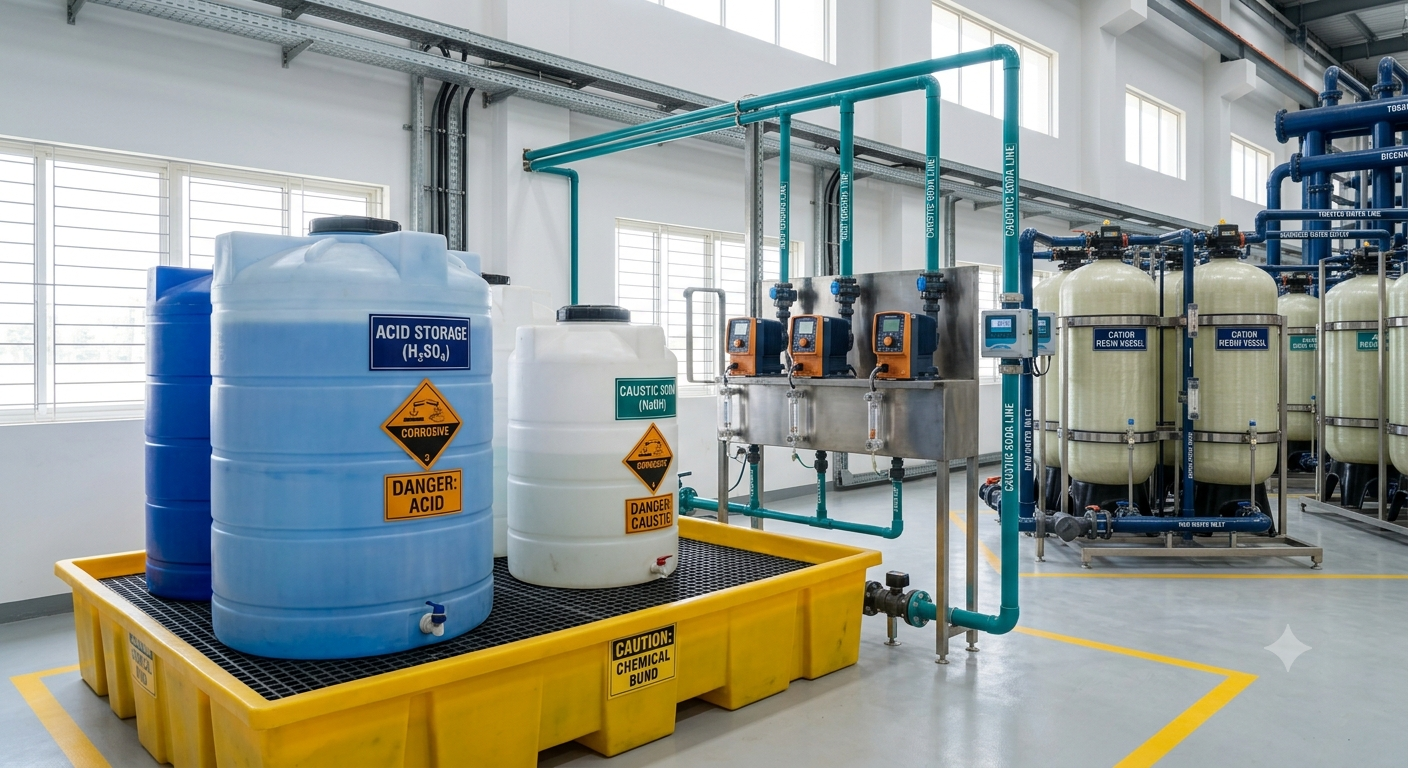
Acid (HCl / H2SO4) for cation, caustic soda (NaOH) for anion. Secondary containment, safety signage in amber, dosing pumps, neutralization pit — industrial mechanical room with teal pipe labels.
Commissioning includes training your operators on safe regeneration procedures, correct chemical strength, and how to read resin exhaustion signs before water quality drifts out of spec.
For facilities running continuous processes or high-pressure boilers — conductivity-based regeneration triggering, reducing risk of human error causing regeneration to be missed or started too early.
For smaller or intermittent operations — cost-effective and reliable, provided operators are properly trained on monitoring output conductivity and initiating regeneration on schedule.
We supply DM plants to thermal power and captive power plants, textile units running high-pressure boilers for steam-based dyeing, pharmaceutical manufacturers, electronics and precision manufacturing, and general engineering plants. Each application has different tolerance for residual conductivity.
High-pressure boilers need < 0.5 µS/cm — strictest purity to prevent turbine scaling.
High-pressure boilers for steam-based processes — consistent steam quality for color fastness.
Purified water as starting point for WFI and further treatment — USP compliance.
Mineral deposits damage sensitive components — near-zero TDS essential.
Steam boilers for process heating — DM water extends boiler life by years.
Sizing always starts with your specific end-use rather than generic 'DM water' request.
DM plants are rarely installed in isolation — they typically sit downstream of softening or RO pretreatment and upstream of boiler or process itself. Our AMC packages cover resin health monitoring, regeneration chemical supply, vessel and valve maintenance, and periodic resin capacity testing.
Two-bed and mixed-bed ion-exchange configurations available
Sized around your raw water hardness, TDS and daily consumption
Manual and fully automatic (conductivity-triggered) regeneration
Safe regeneration chemical storage, dosing and neutralization design
Typically paired with upstream softening or RO pretreatment
Operator training on regeneration and resin monitoring
AMC coverage for resin health, chemicals and vessel maintenance
Resin performance degrades gradually — catching decline early prevents unplanned boiler shutdowns
Even a well-designed DM plant needs consistent monitoring — resin exhaustion happens gradually and is easy to miss without instrumentation. We install online conductivity meters at DM outlet as standard practice, giving operators immediate signal when regeneration is needed.
